Pendant or spotlight on track?
Pendants pull the source toward a place; spotlights direct attention toward a target. The better choice depends on whether the furniture stays still, how the room is viewed and what the light is expected to do.
Review the buying questions2026-10-09 / Trade lighting desk
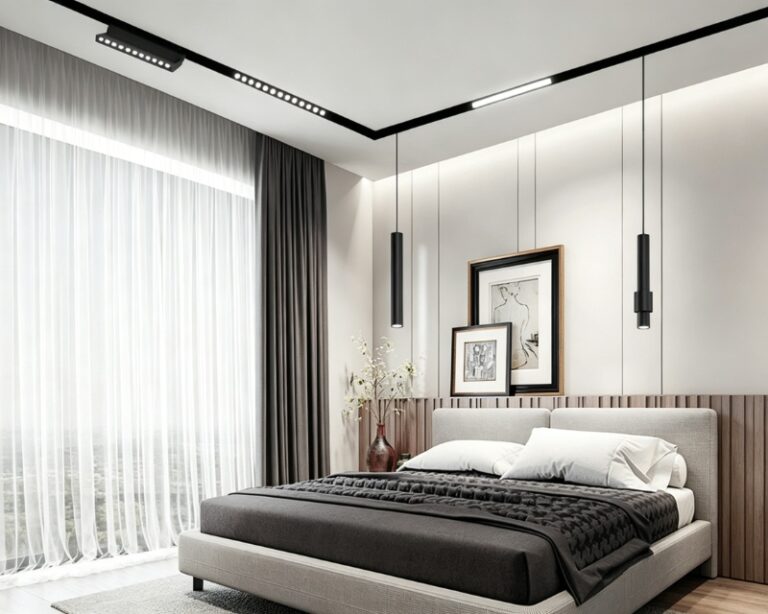
Two fittings walk up to a counter
Over a café counter, the argument starts. A pendant says: I'm the room's punctuation, I hang where the coffee is made, people read the whole place from me. A spotlight, clipped to the same rail, says nothing at all — it just points, precisely, at the thing that needs seeing. Choosing between them isn't really a style contest, though it usually gets dressed up as one. It's a question about what the light over this counter is for.
Name the job first. If the job is a pool of welcoming light over the transaction — the till, the cake stand, the menu board leaning by the register — a pendant does it with a presence a cylinder can't fake. If the job is the rotating art on the back wall, or the retail shelf in the corner, direction wins and the pendant is jewellery in the wrong place. Plenty of counters need both. They just need them decided separately, not averaged into one fitting that does neither thing with conviction.
Sit on the other side before you choose
A pendant lives at eye height, or near it, which means it lives in people's sight lines. Stand where the customer stands. Can you see the person serving you, or are you talking to a shade? Sit where a guest sits. Does the drop land exactly between you and the person opposite — charming in a catalogue photograph, irritating across a forty-minute lunch?
Spotlights keep out of the way; that's their social gift. But they ask something in return: somebody has to aim them, and re-aim them when the display changes. A pendant, once hung at the right height, mostly forgives and forgets. Ask who in this business will actually climb up and re-aim heads after each menu change or window reset. If the honest answer is nobody, weight the decision accordingly. The best-aimed spotlight in the world drifts into irrelevance one reset at a time.
The silhouette won't tell you about the light
Two pendants can share a shape — same dome, same cord, same finish — and pour completely different light onto a counter. One spreads a generous pool that swallows the till and the tip jar. The other draws a tight circle with a hard edge and leaves the card reader in dusk. Judging by silhouette is how counters end up lit like stage sets: beautiful from the street, impractical at the point of sale.
Ask what the fitting does to the surface, not what it looks like above it. And do the same courtesy for the spotlight: a small head with the right optic can wash a menu board more kindly than a large one chosen for its looks. The object matters. It just isn't the evidence.
Check the drop against real heads, real shoulders
Pendant height gets chosen off a drawing, as a dimension. Try it as an experience instead. The drop should clear the eye line of people standing at the counter while still feeling connected to the surface it serves — too high and it detaches, floating like it belongs to the ceiling's plan rather than the counter's life; too low and tall customers negotiate with it. Staff reach across it, lean under it, clean around it. The steam from the machine rises into it.
There's no universal number hiding in this. There's a counter, a clientele, a staff routine. Mock it up with a cord and a paper shade if you have to; five minutes of theatre beats a dimension argued over email. While you're at it, check the view from the door — the pendant row is often the first thing a passer-by reads, and three drops at slightly drunken heights announce themselves immediately.
Tables move. Counters don't.
The counter is the most honest piece of furniture in the room: it isn't going anywhere. A pendant centred on it today is centred on it next year. Tables are traitors. They migrate for group bookings, get pushed together for events, end up in a line by the window for summer. A pendant chosen for a table layout is a pendant chosen for one photograph in the room's life.
Track helps here, if you let it: spotlights can be re-aimed and slid along the rail as the room changes jobs, while a pendant can anchor the fixed point. That division of labour — permanent glow at the counter, adjustable aim everywhere else — suits rooms that earn their living by rearranging themselves. Rooms that never change can commit more boldly to drops over tables. Know which kind of room you have. Be honest; everyone thinks theirs is flexible.
Cleaning day casts a vote too
Grease, dust, coffee steam: a working counter is not kind to anything hanging in it. The pendant's shade will need wiping, its cord will need attention, and someone will have to reach it without dismantling the morning setup. A spotlight needs less surface care but its lens and aim suffer their own slow neglect.
Picture the clean, not the opening day. If reaching the fitting means moving the machine and standing on the counter, it will be cleaned rarely and lit through a film of kitchen weather in between. A slightly less photogenic fitting that a person can actually maintain wins the long game. It always does.
Switching tells you how the room closes
At closing time, the café wants layers: the counter still bright for cleaning and cashing up, the seating gone quiet, the window display alive for the street. If pendants and spotlights share one switch and one mood, the room gets exactly one state — open. Separate the groups in the plan and the room can exhale in stages.
This is a decision to make before ordering, because it shapes what you ask for: which fittings group together, what control they answer to, and what the staff member locking up actually has to do. Write the closing sequence into the brief. "Counter pendants stay on, wall spots off, window spot on low" is a lighting design in one sentence.
Order them as different requests
When the brief goes out, give the pendant and the spotlight their own lines. The pendant line carries the counter, the drop, the sight lines, the cleaning reach. The spotlight line carries its targets, the aiming duty, the reset routine. Both lines carry the same rail identification — because before any of this matters, the fittings have to belong on the track that's actually in the ceiling, and only the rail details can settle that.
Two lines, two jobs, one rail. Suppliers can price that, compare that, answer that. A single line that says "nice lighting over counter area" gets you a photograph in reply.
What the street sees at closing time
Stand outside after dark, in the street, where the passing trade lives. The window is the shop's face, and whichever fitting serves it is doing the most public work in the building. A pendant glowing in the window reads as warmth, occupancy, somewhere you'd cross the road for. A spotlight in the same window reads as intent — a product, lit like it matters, in a dark frame. Both work. They say different sentences to the pavement, and the choice between them there is a branding decision wearing a lighting costume.
This is worth five cold minutes in person rather than another look at the plan. The street view is the one view nobody in the project ever takes during the design meetings, because the meetings happen at a desk, in daylight, indoors. Go out at closing time. See which of your two fittings is telling the truth about the room behind the glass, and whether the one you demoted to a supporting role has quietly become the lead.
If the window belongs to a spotlight, aim it for the pavement's eye level, not the customer's inside — the audience changed sides. If it belongs to a pendant, check the drop against the window frame from outside, where a careless height shows up as a fitting apparently resting on the sill. Small geometry. Public consequences.
Market day doubles the counter
Saturday brings a second, temporary counter — a trestle by the door for the market-day rush, gone again by evening. The fixed pendants keep serving the real counter, exactly as they should; the trestle makes do with a spotlight slid along the rail and aimed for the morning, then slid back. Nobody suggests a pendant for the trestle. Some furniture is permanent, and some is weather.
It's a small scene, but it shows the division of labour working: drops where the room's life is anchored, aim where the room improvises. If your space has both kinds of furniture — most do — the layout should probably honour both, rather than forcing one fitting type to cover for the other's weaknesses.
What should I send Sampo about pendant or spotlight on track?
Show Sampo which tasks belong over the counter and which belong on the wall; include the identified rail and ask what suitable model can be offered for each request.
Ask Sampo about fit