Living room track lighting ideas that serve the room
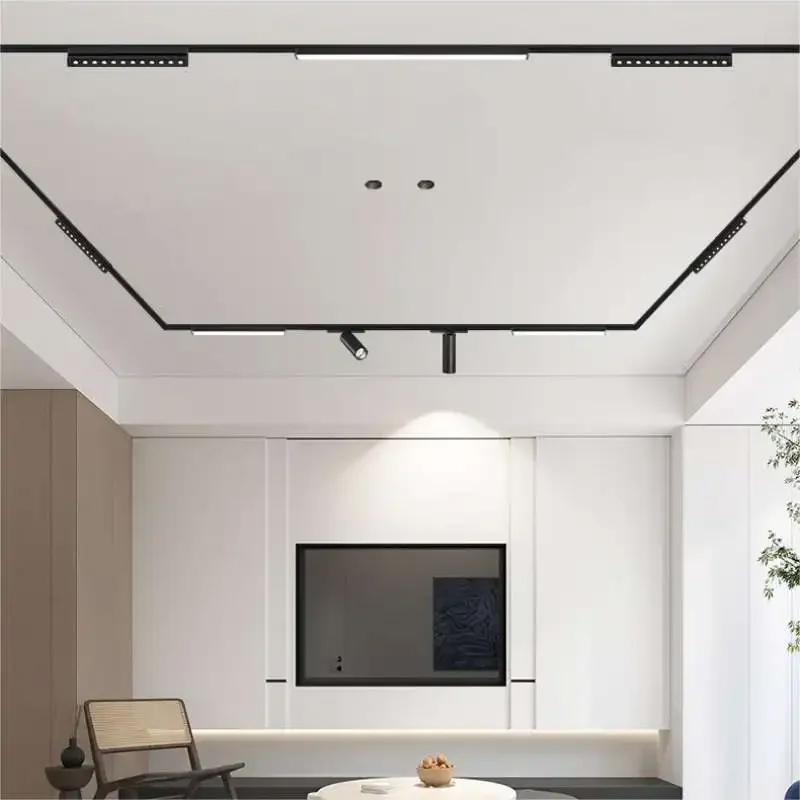
A ceiling layout should make the living room easier to use. The best-looking track arrangement is often the one that respects the sofa, gives favourite objects attention and stays out of the television view.
Review the buying questions2026-10-06 / Trade lighting desk
Sit down first
Every living room lighting plan I've seen drawn from above has the same flaw: nobody lives at ceiling height. So before the plan, do the unfashionable thing. Sit in your chair. The one that's actually yours, with the cushion compressed to your shape. Look around at standing-person height minus a bit, which is where you spend your evenings, and notice how different the room's geography becomes. The picture you never look at from the doorway is right in front of you. The corner everyone photographs is in your peripheral vision, being ignored, as usual.
Track lighting gets bought from the ceiling's point of view and lived with from the sofa's. Start from the sofa. The ceiling can catch up.
Not every wall deserves a moment
There's a pressure, once a rail goes up, to give every surface its accent — the picture wall lit, the alcove lit, the plant in the corner lit like it's about to be interviewed. Resist. A living room needs enough general light to cross it safely with a cup of tea, and it needs its accents like a sentence needs its stressed words: sparingly, or nothing stands out.
Pick the one or two things in the room that earn emphasis. Usually they're the things people already look at — the big picture, the bookcase end, the fireplace if there is one. Let the rest fall quieter. A room where everything is highlighted has no highlights; it just has a higher electricity bill and a faint sense of being in a showroom. Your home is allowed to have shadows. They're where the eye rests.
Pictures have glass in front of them
Framed pictures behind glass — which is most of them — are mirrors with ambitions. Aim a head at the canvas and the glass may return the favour, throwing the source straight back at whoever sits opposite. From the ladder, the picture looks beautifully lit. From the sofa, it looks like a lamp with a painting behind it.
Check from the seats, plural, because the reflection moves: what's clean from the armchair glares from the sofa's far end. Sometimes angling the head more steeply, so the reflection bounces down toward the floor instead of across the room, solves it. Sometimes the honest fix is a matt-framed picture or a head serving that wall from further along the rail. What won't help is brightness. Turning up a reflection gives you a brighter reflection.
The television keeps score
A dark screen is the most honest mirror in the house. Sit where you watch from, screen off, and look at what it shows you: the window, probably — and any track head careless enough to sit in its field. That reflection will be there for every film, every match, ghosting away in the dark scenes. Evening viewing is half the reason the room exists; a lighting scheme that taxes it nightly is a scheme that gets switched off nightly, and lights that stay off are just expensive ceiling decoration.
This doesn't banish track lighting from the TV wall. It means the heads serving that side of the room earn extra scrutiny, and the wall opposite the screen — the one the screen reflects — might do better with low, wide light or none. Test with the screen off, from the actual seats, before the positions harden into an order.
Reading is a place, not a setting
Your reading chair wants light arriving over a shoulder, landing on the page, and it wants that whether the rest of the room is bright for guests or sunk low for a film. Follow the page, literally: sit, open the book where you hold it, and see where a beam needs to come from. A head that's gorgeous for the picture wall may rake across the page at exactly the wrong slant, and no scene button will move it two feet left.
If the chair is yours for the long term, it's allowed to anchor a decision — a head positioned for it, in a group it can share sensibly with the room's evening state. If the furniture migrates with the seasons, that's a different room and the plan should admit the migration rather than pretend the chair has a permanent home.
Daylight judges the hardware
By day, the lights are off and the track itself is the exhibit: a line of black cylinders on a pale ceiling, or white on white, or whatever combination you chose at midnight from a screen. Judge it at noon. Does the rail read as an intentional line — something the room's architecture can carry — or as an apology, a bit of kit that landed there? Rooms differ. A beamed ceiling, a cornice, a bold wall colour can absorb hardware that would shout in a plain white box.
Finish is part of this, and so is sheer quantity: a sparse run looks intentional, a crowded one looks like a departure board. If the daytime view bothers you in the showroom photographs, it will bother you at breakfast. Choose accordingly, and remember you are buying two products — the light at night and the object by day.
Evening scenes, kept understandable
Groups and settings are only worth having if the household can run them half-asleep. Think in evenings, not features: people arriving and the room bright enough to greet them; the long middle of the night with conversation here and a reader there; the film state; the last-person-up state, one corner lit, everything else forgiven. If your scheme can produce those four with combinations a guest could guess, it's a good scheme. If it needs a phone, a login and a tutorial, it will be used at exactly one setting forever, and that setting will be "all on".
Decide the groups while the layout is young. Which heads keep company with which? The answer comes from the evenings, not from the ceiling's geometry — heads that share a job share a group, even if they're not neighbours on the rail.
The last check happens in your slippers
Run the final review the way the room gets used. Doorway view, yes — visitors do arrive through it — but then the long views: from the sofa at programme time, from the reading chair at chapter twelve, from the kitchen doorway with a mug in hand at midnight. Those are the views the scheme has to survive, repeated hundreds of times, judged by people who've stopped being polite about it.
And draw the furniture move you're already half-planning — the sofa turned toward the window in spring, the chair swapped for the desk at exam time. A track scheme's one true luxury is that heads can slide and re-aim. Make sure the layout you order leaves that luxury usable, and send the supplier the version of the room with the awkward views marked in. That's the room you'll actually be lighting.
Guests see a different room
One more view to check, and it's the one you'll never have: the visitor's. Guests read a living room the way you read a hotel room — all at once, from the door, without the softening effect of habit. They notice the picture wall you lit, and they notice, with the clarity of strangers, the corner you never fixed and the head that shines in their eyes when they take the offered seat.
You can't sit where a guest sits and see it fresh; your eye has a thousand evenings of context. But you can borrow the trick: take a photograph from the doorway and look at it somewhere else — at work, on a train — where the room is just an image and not your life. The glaring head announces itself. The dead corner confesses. It's the closest thing to a stranger's eyes that a homeowner can rent for free, and it costs one photograph.
Then fix what the photograph found and stop. A living room scheme doesn't need to be perfect; it needs to be kind at the seats, honest at the screen, and quiet everywhere else. Get those three right and the room will do what living rooms are for — it'll disappear behind the evening happening inside it, which is the highest compliment lighting can earn.
The armchair inherits the window corner
It happens quietly. The reading chair migrates to the window corner — better light by day, better view, no committee decided it — and the evening arrangement now has a reader sitting outside the pool of light the plan built for her old position. The track earns its keep here: a head slides, an aim changes, the reading group gains a member.
What makes it a five-minute job rather than a saga is that the groups were decided by evenings, not by ceiling geometry. The moved chair joins the reading group because that's its job now. Keep the plan updated with a pencil, and the room's next quiet rearrangement will be just as painless.
What should I send Sampo about living room track lighting ideas that serve the room?
Share the furniture sketch and the uncomfortable seated views with Sampo, alongside the rail details, to discuss a head for the actual room tasks.
Ask Sampo about fit