Aiming track heads for retail displays
The head is installed, the display is finished and the merchandise still looks flat. Before adding more light, look at where the existing heads point and what the customer sees while approaching the product.
Review the buying questions2026-10-12 / Trade lighting desk
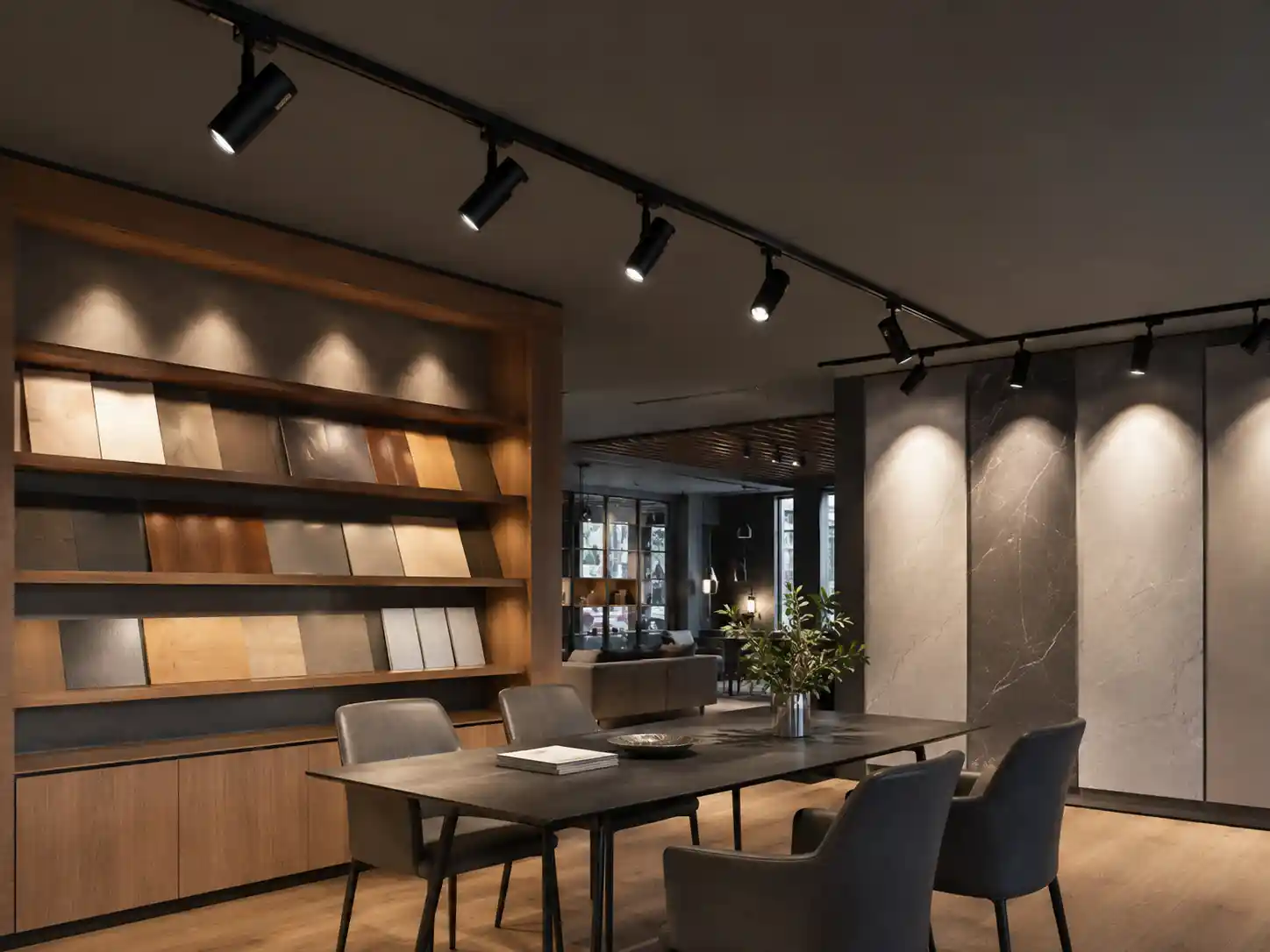
Start at the door, not at the ladder
Walk in the way a customer walks in. That's the whole trick, and it's surprising how often it gets skipped. The ladder comes out, somebody climbs up, twists a few heads until the wall looks bright from above, and the job gets called done — except nobody shops from up there. In a shoe shop I keep picturing, the feature trainer sits on a plinth just inside the entrance, the stock wall runs down the left, and the till is at the back where the light is always worst. Three different jobs. One ceiling.
Take a phone photograph from the doorway before you touch anything. Mark the first thing your eye lands on, then the secondary displays, then the places where people actually have to read something — size labels, price tickets, the card reader screen. It takes five minutes. It also stops the most common aiming mistake, which is lighting the architecture instead of the merchandise.
The wall is not the product
A flat wall accepts light gracefully. A shoe doesn't. It sticks out from the shelf, toes pointing down the aisle, and the face that sells it is angled away from the ceiling. Coats hang forward of their rail. Bottles curve. So pick the surface that matters — the toe cap, the label, the front of the folded knitwear — and trace the line back to the head. What's in the way? A shelf edge, usually. Or a hanging sign. Or the neighbouring product, which nobody moved because in the tidy plan view it wasn't there.
Don't judge the result by the neatness of the patch on the wall behind. Judge it by whether the product reads clearly from the spot where a person stops. A bright halo around a dim shoe is a failure wearing a nice frame.
Come down and walk the aisle
Once a head looks right from the ladder, get down and walk past at normal speed. Turn toward the display the way you'd turn toward a size run you're hunting for. Pause. This is where the uncomfortable discoveries happen: the source itself sitting right in your eyeline, a reflection bouncing off the mirror by the benches, a dark gap exactly where the sale rail starts.
It helps to work in pairs. One person stays by the display and nudges the head; the other calls out what they see from the entrance, mid-aisle and the till queue. "I can see the lamp itself as I pass the mirror" is useful feedback. "Looks fine" is not. And if a direction turns out to be genuinely uncomfortable, don't fix it by brightening everything else until the whole shop is equally glaring. Move the head, change the angle, or accept a different head for that spot. Aiming has limits, and pretending otherwise just spreads the problem around.
Every shelf is a little roof
The top row photographs beautifully. The rows underneath live in shadow — not because the light is weak, but because each shelf cuts the beam like a roof cuts rain. Adding power from the same angle won't reach under the roof. It'll just make the top row harsher.
Start at the bottom shelf and work up. Crouch where a customer crouches. Can you read the label on the lowest product without leaning into the unit? When someone pulls the front item out, is the row behind it lit or does it fall into a cave? Does the shelf above clip the beam before it reaches the product face? Those three answers tell you more than a light meter reading taken at the brightest spot. Sometimes the answer is a head positioned further out with a steeper angle. Sometimes it's splitting the run so one head serves the low shelves and another takes the top. Either way, decide from the bottom shelf. It's the one that gets ignored, and it's usually at eye level for a seated or shorter customer.
Bright islands, or one calm wall
Stand back and look at the whole run. A row of tight, bright pools with dark gaps between them makes a long wall feel jittery — fine for a trainer wall where each group is its own shout, wrong for a run of knitwear that's meant to read as one calm story. There's no formula here. Squint. If the wall flickers as your eye travels, the rhythm is off.
Try adjusting one neighbouring pair first and live with it for a minute before rolling the change down the whole wall. Overlap is a judgement call, not a spacing calculation: the distance between rail fixing points says nothing about how the light should behave. What you're after is a wall that holds together from the end of the aisle, where the customer first sees it whole.
Packaging fights back
Glossy boxes, cellophane, curved bottles, foil logos — retail packaging throws light back at the aisle, sometimes straight into people's eyes. The display can look perfectly lit from behind the till and still assault anyone approaching from the door. So check from the buying position, and check at an angle, because nobody approaches a shelf perfectly square-on.
A small rotation of the head often fixes it. Or a nudge along the rail. What won't fix it is more output. If a particular product line keeps misbehaving, note it on the aiming record, because the next range change will bring the same problem back wearing different colours.
Daylight cheats, evening tells the truth
A morning trial in a shop with a big window is a liar. The window does half the work, everything looks balanced, and then at five on a December evening the back wall falls away and the feature plinth is lit like an interrogation. If the shop trades after dark — most do — the aiming has to be checked after dark, or at least with the blinds down and an honest attempt to recreate the evening balance.
The reverse happens too. A display tuned at night can look flat and over-lit at noon. You can't optimise for both with fixed heads, so tune for the hours that make the money and accept a compromise the rest of the day.
Write it down, or do it all again in March
Displays change. Staff re-aim heads by instinct, a ladder comes out for a promotion, and by the next reset nobody remembers which head served which shelf or why that one was angled so steeply. A simple record ends the archaeology: a marked-up photograph per display, one line per head saying what it serves, and a note of any head that couldn't reach its target properly.
That last part matters for buying. "Head 6 can't reach the low sale rail" is an enquiry waiting to happen — it tells a supplier exactly what problem a replacement needs to solve. Keep the record with the plan, update it when the display changes, and the next aiming session starts from knowledge instead of from a ladder and a hunch.
The checkout deserves its own aim
Displays get the glory, but the till is where money and patience are spent, and it's often the worst-lit square metre in the shop. Staff read screens, handle returns, spot the difference between two near-identical shades of foundation under light that was aimed for the wall behind them. Customers watch their total appear. If the checkout glows like a shrine while the queue stands in gloom — or the reverse, a bright island of customers facing a dim till — somebody's aim was decided by habit rather than by looking.
Give the transaction the same treatment as the merchandise: stand where the customer stands, then where the staff member stands, and judge both views. The head serving the till has a different job from the one serving the feature plinth, and it deserves its own line on the record, its own compromise, its own occasional complaint. Shops remember to aim at what they sell. The better ones also aim at where they sell it.
Then the sale rail moves to the window
End of season, and the sale rail gets dragged to the window where the light is somebody else's problem — daylight's. The heads that served it all winter are now pointing at a rail of full-price stock, and the window display, which the old arrangement ignored, suddenly has to sell to the pavement. Before ordering anything new, walk it again: what does the window need at dusk, when the street is dark and the shop is a lit box?
Half the answer is usually re-aiming what exists. The rest — a head that can't reach, a direction that puts the source in the eyes of people on the pavement side — goes on the record as next season's enquiry, written while the problem is still visible instead of reconstructed from memory in October.
What should I send Sampo about aiming track heads for retail displays?
Send Sampo the marked display photograph, the rail details and the aim your existing heads cannot reach; ask about a suitable replacement head and its optical information.
Ask Sampo about fit